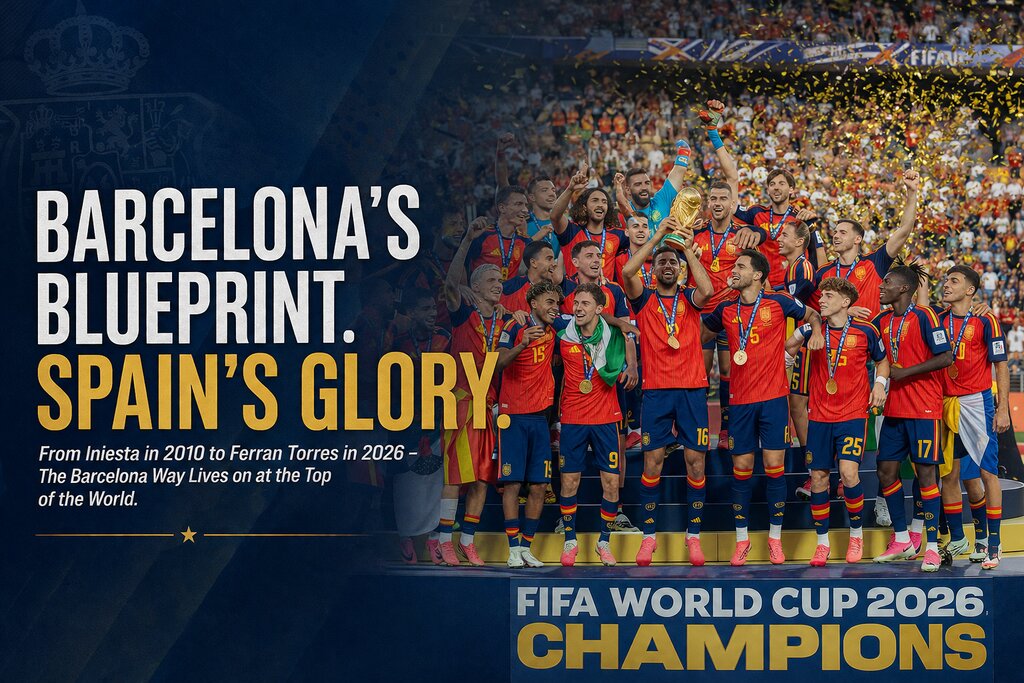
As the confetti finally settles in Madrid following Spain’s dramatic 1–0 extra-time triumph over Argentina at MetLife Stadium on Sunday, football analysts are doing what they always do after a World Cup: dissecting how a champion was built.
It felt like history repeating itself in New Jersey. In 2010, it was Andrés Iniesta—Barcelona’s quiet magician—who struck in extra time in Johannesburg to give Spain their first world cup win. Fast forward sixteen years to July 2026, and it was another Barcelona forward, Ferran Torres, snapping a 0–0 deadlock in the 106th minute to claim Spain’s second.
Coincidence? The debates have erupted on football podcasts and tactics boards worldwide: Is Spain’s international reign fundamentally dependent on FC Barcelona?
The 2010 Blueprint vs. The 2026 Reality
To understand why this connection exists, you have to look at how Spain stopped being international football’s perennial underachievers.
Before 2008, Spain was notorious for individual talent that never quite meshed into a cohesive unit. Everything shifted when the national team stopped trying to forge a generic identity and simply adopted FC Barcelona’s operational blueprint wholesale.
When Vicente del Bosque marched onto the pitch in South Africa in 2010, he fielded seven Barcelona players in the starting XI. The telepathic midfield connection of Xavi, Iniesta, and Busquets wasn’t built during two-week international breaks; it was forged over thousands of hours together at the Ciutat Esportiva Joan Gamper.
In 2026, the names on the back of the shirts have changed, but the address on their youth passports remains remarkably consistent. Spain’s dominant run across North America was spearheaded by a terrifyingly young core raised in La Masia. Lamine Yamal terrorized defenders on the right, Pau Cubarsí held the backline with veteran-like calm, and Pedri dictating tempo from deep meant Spain never surrendered control.
Tactical DNA: How La Masia Teaches “Spain’s Game”
It isn’t just about sending bodies to the national team camp; it’s about tactical instincts.
Barcelona’s youth academy instills positional play (Juego de Posición) from the age of seven. When a La Masia graduate steps into Spain’s midfield, they don’t need an instruction manual on spatial awareness, press resistance, or body orientation—they’ve been doing it on muscle memory for a decade.
- Possession as Defense: In the 2026 final, Spain restricted Argentina to almost zero clean chances in regulation. They did it by keeping the ball.
- Instant Pressing: The moment possession is lost, former Barcelona players naturally hunt in packs within five seconds—a signature trait inherited directly from Pep Guardiola’s tactical legacy.
The Final Assessment
Barcelona doesn’t win international trophies on its own—national team success always demands contributions from across La Liga and Europe.
However, Barcelona provides the engine, the language, and the technical standard. When Barcelona’s academy is producing generational talents, Spain dominates the world stage. When Barcelona stumbles, Spain usually follows.
As we watch this new era of Spanish stars celebrate their 2026 World Cup crown, one reality is undeniable: Barcelona remains the heartbeat of Spanish footballing greatness.